
Request a Call

<svg xmlns="http://www.w3.org/2000/svg" width=" 100%" height=" 100%" viewBox="0 0 59.783 59.783">
<g id="Project_Managers" data-name="Project Managers" transform="translate(0.63 0.63)">
<path id="Path_22887" data-name="Path 22887" d="M24.519,5.87a10,10,0,0,1,5.876,9.1v3.964H9.84V14.972a10,10,0,0,1,5.876-9.1" transform="translate(9.144 5.207)" fill="none" stroke="currentColor" stroke-linecap="round" stroke-linejoin="round" stroke-width="2.5"/>
<circle id="Ellipse_343" data-name="Ellipse 343" cx="5.776" cy="5.776" r="5.776" transform="translate(23.485 0.62)" fill="none" stroke="currentColor" stroke-linecap="round" stroke-linejoin="round" stroke-width="2.5"/>
<line id="Line_579" data-name="Line 579" y2="4.501" transform="translate(29.321 12.949)" fill="none" stroke="currentColor" stroke-linecap="round" stroke-linejoin="round" stroke-width="2.5"/>
<path id="Path_22888" data-name="Path 22888" d="M27.159,39.079H12.778A2.8,2.8,0,0,1,9.99,36.291v-13.9A2.8,2.8,0,0,1,12.778,19.6h14.38a2.8,2.8,0,0,1,2.788,2.788v13.9A2.8,2.8,0,0,1,27.159,39.079Z" transform="translate(9.293 18.823)" fill="none" stroke="currentColor" stroke-linecap="round" stroke-linejoin="round" stroke-width="2.5"/>
<path id="Path_22889" data-name="Path 22889" d="M32.334,39.079H26.378a2.8,2.8,0,0,1-2.788-2.788v-13.9A2.8,2.8,0,0,1,26.378,19.6h5.955a2.8,2.8,0,0,1,2.788,2.788v13.9A2.8,2.8,0,0,1,32.334,39.079Z" transform="translate(22.78 18.823)" fill="none" stroke="currentColor" stroke-linecap="round" stroke-linejoin="round" stroke-width="2.5"/>
<path id="Path_22890" data-name="Path 22890" d="M9.364,39.079H3.408A2.8,2.8,0,0,1,.62,36.291v-13.9A2.8,2.8,0,0,1,3.408,19.6H9.364a2.8,2.8,0,0,1,2.788,2.788v13.9A2.8,2.8,0,0,1,9.364,39.079Z" transform="translate(0 18.823)" fill="none" stroke="currentColor" stroke-linecap="round" stroke-linejoin="round" stroke-width="2.5"/>
<line id="Line_580" data-name="Line 580" y2="14.241" transform="translate(29.261 24.162)" fill="none" stroke="currentColor" stroke-linecap="round" stroke-linejoin="round" stroke-width="2.5"/>
<path id="Path_22891" data-name="Path 22891" d="M49.221,23.14V20.173a4.161,4.161,0,0,0-4.163-4.163H7.713A4.161,4.161,0,0,0,3.55,20.173V23.14" transform="translate(2.906 15.263)" fill="none" stroke="currentColor" stroke-linecap="round" stroke-linejoin="round" stroke-width="2.5"/>
</g>
</svg>
Do I need to hire an eLearning Project Manager?
An eLearning Project Manager ensures training initiatives run smoothly, stay on schedule, and remain on budget.


Plan My Ride: An eLearning Program for Safe Driver Education
How a Research-Based, Accessible, eLearning Program Prevented Teens from Being Distracted and Impaired While Driving
It gave me some good helpful reminders to think about when I’m driving.
Young adult learner
Client
Innovation Research and Training (iRT) was founded in 1999 by Dr. Janis Kupersmidt to fill the many gaps among basic research findings, social policy, intervention, prevention programs, and clinical practice. Because of iRT’s foundation in the social, clinical, and behavioral sciences, the company has a unique commitment to the application of the most current scientific findings, methods, and best practices to identifying and solving significant real-world problems facing children, families, communities, organizations, and other social systems.
iRT applies cutting-edge clinical and technical knowledge to help others develop and evaluate evidence-based programs and services.
Challenge
Car crashes are the leading cause of preventable death among young people. Many of these crashes are the result of impaired driving – whether due to alcohol, drugs, drowsiness, or distraction. While there are many programs on learning how to drive, there are few safe driving programs that focus on the communication and planning skills needed to avoid distracted and impaired driving in ways that are appealing to teens - prone to risky behavior. Teens are generally difficult to engage with in educational online training.
Program Objectives
The Plan My Ride program has four primary objectives for teen and young adult drivers.
- To improve seatbelt use (while maintaining a safe speed and managing emotions while driving)
- To reduce distracted driving
- To prevent drinking alcohol and using drugs while driving
- To enhance effective communication as a driver or passenger
Challenges
1st Challenge: Appeal to Teens & Young Adults
Creating a program that was appealing and engaging to the target audience learning to drive. The course had to appeal to the digital savviness and diversity of this audience.
2nd Challenge: Program Assembly
Coordinating the different components of the program. All content aspects had to be consistent and be integrated into the course modules in Lectora.
3rd Challenge: Accessibility
Creating content that was both accessible and mobile-friendly for all learners. Due to the ubiquity and heavy usage of mobile devices among this audience, the course had to support where teens most frequently interacted with content- mobile devices. The other goal was to create content that was accessible to those with visual and auditory impairments.
Strategy & Solution
Strategy
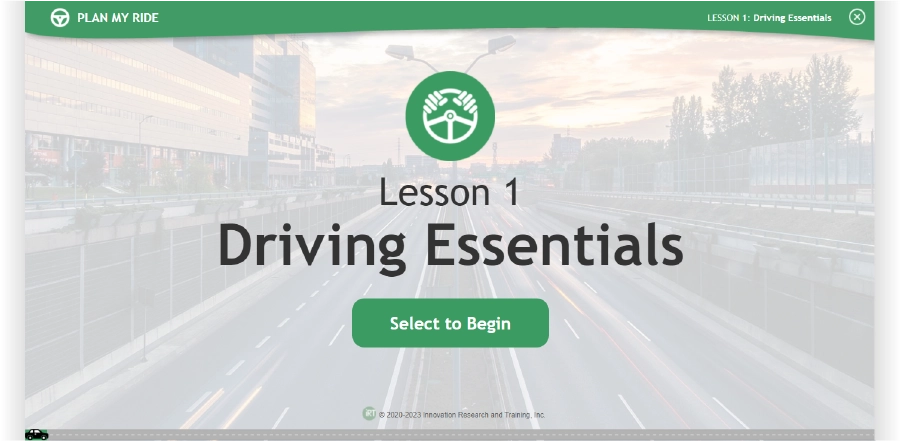
The strategy for the Plan My Ride program was to create a theory-informed, highly engaging eLearning program for teens and young adults. There are three components of Plan My Ride:
- 7 eLearning modules
- 3 360-degree interactive scenarios
- 4 microlearning booster modules
The interactive program was grounded in the Integrated Behavior Model of Behavior Change to target and address the necessary knowledge, beliefs, and attitudes to promote safe driving. 360-degree, interactive videos built using CenarioVR, provided learners with an opportunity to simulate real-life situations and practice using the knowledge and skills they learned in the eLearning modules. The simulated environment created a realistic situation for learners to practice getting out of dangerous situations without the fear of peer pressure, injury, or death. In addition, information was available for the learner to view as needed. The scenes take place in a safe space (VR) where they are encouraged to explore and ask questions while simultaneously processing new information.
The microlearning boosters were designed to reinforce the eLearning and were delivered 8 weeks after completing the initial 7 modules. The content was developed with Lectora and are approximately 5 minutes each.
Design
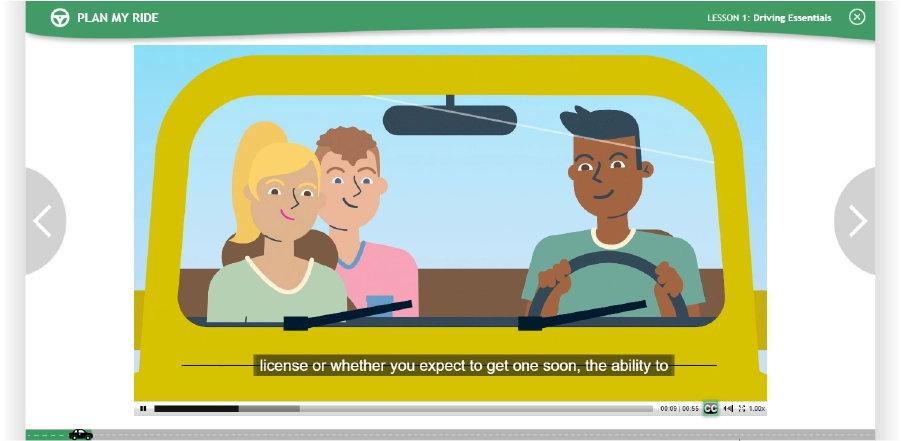
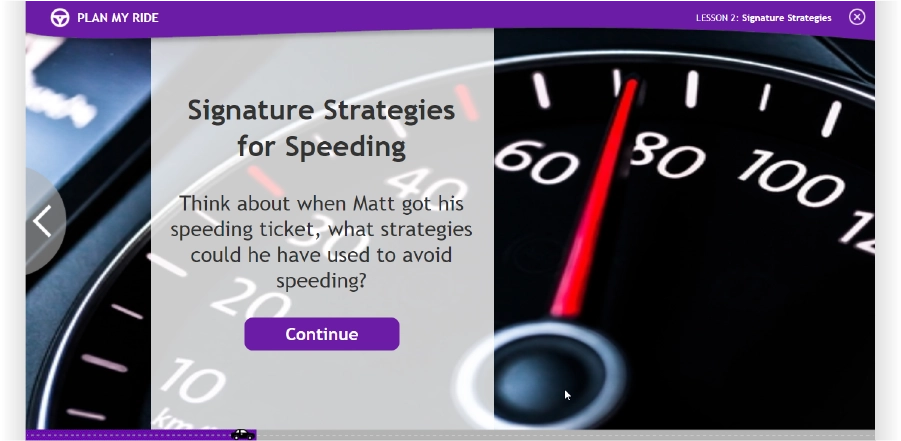
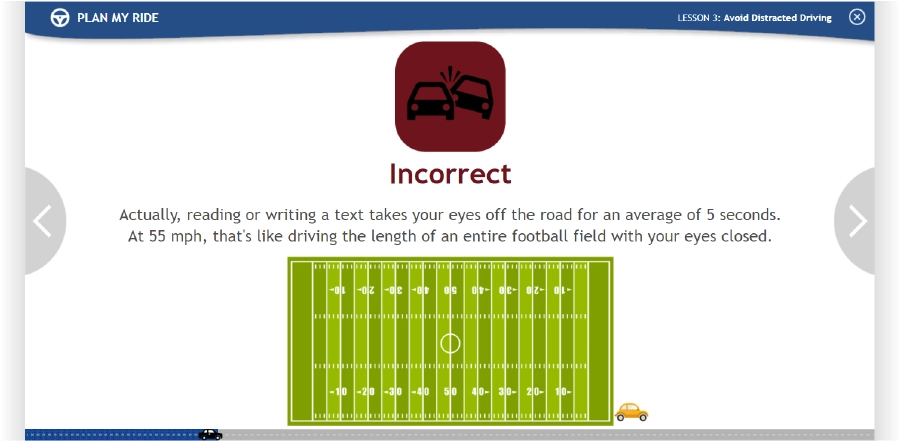
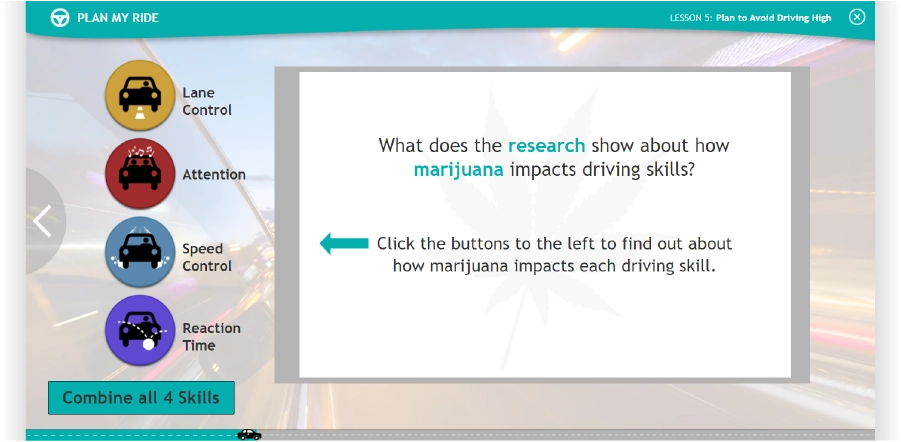
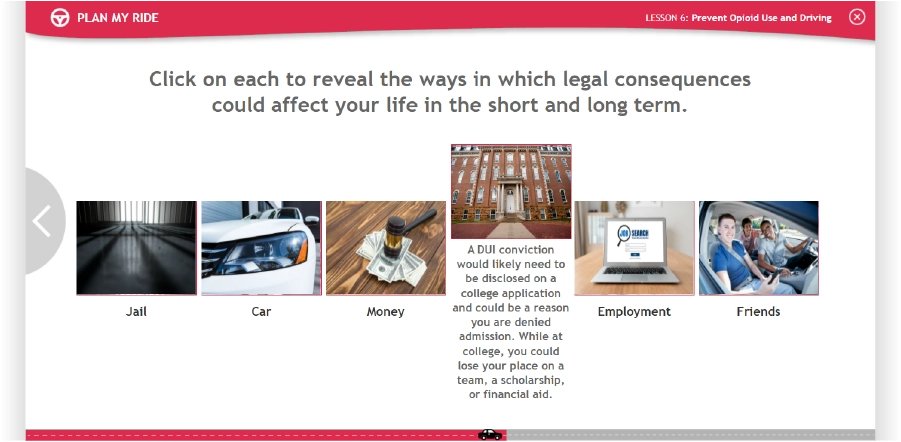
A cohesive and eclectic design was envisioned for the Plan My Ride program to appeal to teens and young adults. A bold color palette was developed for the program with individual corresponding colors for each program component. A steering wheel logo was developed that also formed the basis for the Wheelie “character” who appears throughout the program. Car imagery continues in the progress bar and many animations.
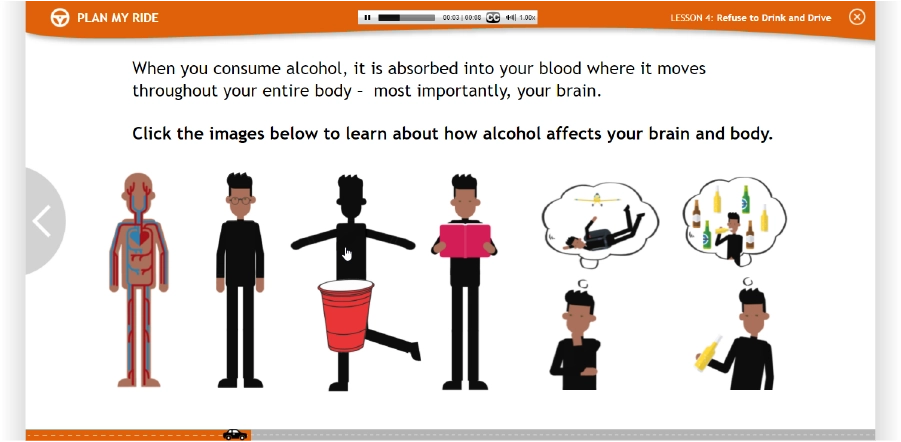
The animations featured characters depicting participants with diverse ethnicities and clothing. Although three separate firms created the animations they all have a cohesive look and feel with the same custom-created matching icons.
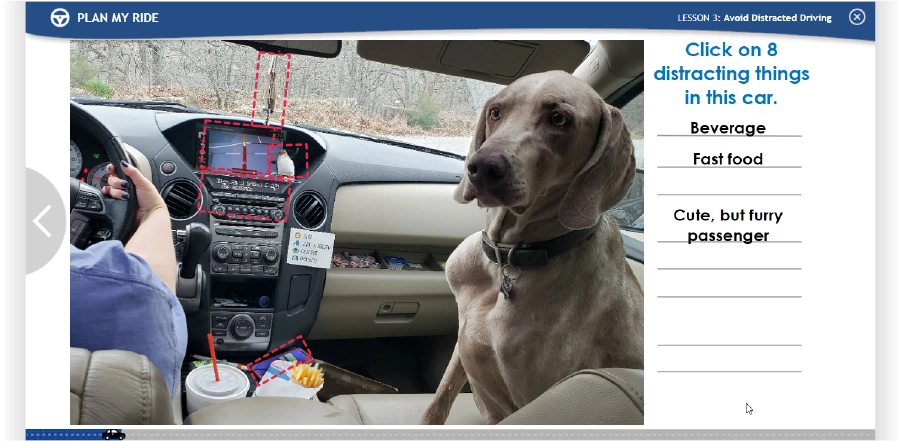
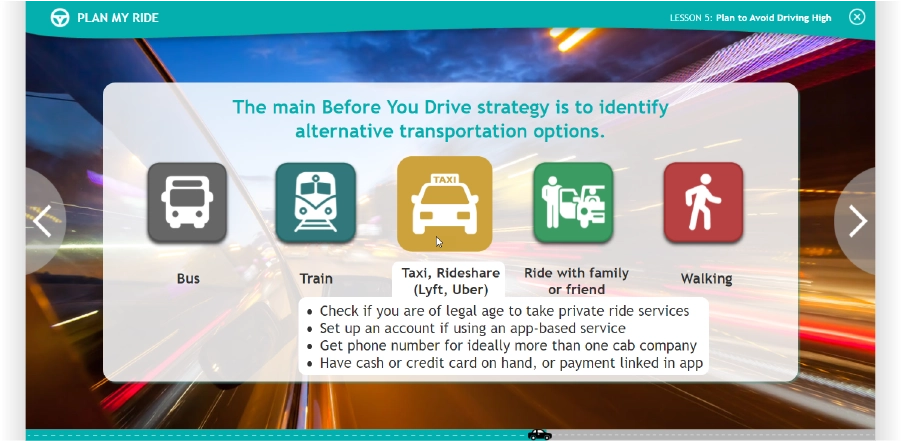
To grab the learner’s attention, engaging elements such as sound effects, a video demonstrating nonverbal refusal skills using a mime, and multiple animations inspired by “Back to the Future” movies provide examples of why controlling your emotions when driving is important. Furthermore, engaging activities designed to reinforce knowledge include custom “mad libs”. In this activity, the learners must arrange for a ride to avoid driving impaired, and end up with a fun mad lib based on their choices. The follow-up boosters include a scrolling design with minimal graphics, large buttons, and simple animations.
While the entire program is designed to be engaging, mobile-responsive, and appeal to teens and young adults, the program was also designed to meet Section 508 Web Content Accessibility Standards. To assist in this process, Universal Design for Learning (UDL) was used in the discussion and development phases, considering the broad range of learners and their digital needs for sensory, physical, and/or cognitive impairments.
The entire program was built with Lectora due to the accessibility features, options, and tools.
Implementation Plan
The Plan My Ride program is implemented through eTrove, iRT’s custom learning management system. Teens and young adults are enrolled in the program and access the program through a computer or mobile device. Their progress is saved and they receive reminders to complete the program via email and text messaging. Upon completion of the modules, participants receive email and text notifications 2, 4, 6, and 8 weeks later that they have access to the booster microlearning.
Results
After taking Plan My Ride, the teens demonstrated increased knowledge about safe driving, a better perception of the danger of distracted and impaired driving, and higher confidence in their ability to use the skills to avoid distracted driving.
There was also a notable improvement in their intentions to avoid riding with a distracted or impaired driver and avoid these behaviors themselves.
The Plan My Ride program is currently being evaluated in a randomized controlled trial with over 350 teens and young adults ages 14-21 years throughout the U.S. to determine if the program is effective. To date, over 170 teens and young adults have completed the Plan My Ride program and responded to a survey after completing the program.
Survey results included;
- 7.49/10 rating indicating they would highly recommend the program to a friend, teacher, or parent.
- 5.49/7 rating indicating overall satisfaction with the program
- An average score of 73.8 on the Systems Usability Scale, which is above the industry average of 68.
- 5.54/7 rating indicating their satisfaction with the booster lessons
- 2.23/7 rating for the level of difficulty in completing the boosters, indicating it was relatively easy to complete.
Feedback received high praise from teens and young adult learners (age 14-21) surveyed:
- Videos were very well thought out and enjoyable to watch.
- It wasn't boring or lame and I did learn some stuff.
- I liked the scenarios!
- It gave me some good helpful reminders to think about when I’m driving.
- Videos were very well thought out and enjoyable to watch.
- I liked how in-depth the lessons were.
- I like how it was able to quickly integrate different aspects of safe driving into several small lessons, I feel like they transitioned into each other well.
- I liked that it was consistent and gave real-life scenarios that anyone could relate to.
- I liked how it was interactive
- It wasn't cheesy
In addition to the current, ongoing research study, a previous pilot research study evaluating a previous version of the Plan My Ride program with approximately 50 teens research study yielded promising results.


Connect


